Saturday, 26 October 2013

Hold the line..

Putting you through now Sir!

One of my favourite diversionary tactics is to order something through the post and then spend a lot of time thinking about it when it arrives. This is entirely regardless of whether it actually relates to anything currently sitting on my desk. In this current example I now have a large box sitting where the Shermans ought to be with lots of very nice counters in it. To be fair, I've had this for a while but my recent postal arrival has caused me to rummage like a TB stricken badger and fill the study with STUFF!

The reason for this is the publication of Highland Charge by Worthington Games. This is a supplement to Frederick's War which has also been recently published. These games form part of an eclectic range of games known generically as Hold The Line, although each game has subtle differences. They usually have a 13 by 9 hex map and all have pretty much the same set of simple rules, reminiscent of Memoir 44/CnC but without the cards.


I have therefore rummaged out my Hold the Line game to allow me to play with Highland Charge.

It is probably worth starting at the beginning and seeing where this series of games came from. Initially, Worthington published Clash for a Continent about the American Revolutionary War (is this what we call it now?) and the French and Indian Wars. This was followed by a really interesting game on the War of 1812 called For Honor and Glory. not only did this cover the land battles but also the naval combats on the great Lakes and offshore (I mean at sea as usually naval combat is offshore).


Clash for a Continent

These two games came with thin wooden counters, a little like the CnC blocks from GMT. Both games seemed to take off with miniatures players, with many examples of the games being converted to large scale hex grids on material and played with toy soldiers. I suspect people were attracted by the simplicity of the games and the multiple scenarios. This next shot shows Lundy's Lane from For Honor and Glory which, I think, proves the point.


Lundy's Lane scenario


Both of these games were released in 2005 and are now out of print. I don't think they will ever be reprinted in their original format.

In 2008 Worthington published Hold the Line, a tidied up version of Clash for a Continent featuring completely new scenarios and some fantastic big counters made in Germany.


These counters are card but so thick they sound like plastic when you shuffle them together!


I understand that the earlier Clash for a Continent/For Honor and Glory scenarios can be played equally well with this set, unfortunately Worthington have not made a PDF of the earlier scenarios available. This is  great pity especially as people, like me, would be prepared to pay for them. You can, however, see the scenarios on the relevant Vassal module (of which I know nothing).

In 2010 Worthington took a slight diversion and released Napoleon's War: The 100 days. This looked at the four battles of the 1815 campaign in Belgium. These games used plastic troops rather than counters (like Memoir) and gave up the limited size map and terrain tiles for a series of bespoke printed maps. These looked really good....

Waterloo map with plastic figures

This was followed-up by release of two battle packs featuring new maps for four battles each (Alexandria, Jena, Auerstadt and Bussaco in Pack I with four battles from 1812 in Pack II). These used the plastic playing pieces from the 100 Days game. A second major release with plastic pieces was issued in 2011, Napoleon's War II: The Gates of Moscow covering Borodino, Aspern-Essling, Austerlitz and Marengo.

None of these games are badged as Hold the Line, but the basic rules and game play are very similar.

The latest releases are Frederick's War covering the Austrian Succession and the aforementioned Highland Charge. Frederick's War has some eight scenarios including the big ones such as Mollwitz and Kolin. This returns the series to the 13 by 9 map with terrain tiles and with counters. Smaller square counters this time, not half as nice as the earlier ones but still pretty good. This game features some rules changes to better fit with the larger scale of the battles.

Highland Charge is an expansion covering five scenarios from the '15, '19 and '45 uprisings (Sheriffmuir, Glen Shiel, Prestonpans, Falkirk and Culloden). Killikrankie is also available as a download from Worthington. Here is the counter artwork....


Nice. However, there are some issues with Highland Charge. Sean Chick, the designer, has flagged up some errata including missing counters (promised in the next expansion) and some rules clarifications. Although the rules are simple they are quite difficult to follow and I'm sure there must be a more simple way of expressing them

I don't have Frederick's War but I intend to play Highland Charge using my HTL map and tiles. The latest set of rules (Frederick's War) are required to play the game but these are available on Worthington's website.

If the above narrative is slightly confusing, here is a quick ludography (?) of the series.

  • 2005: Clash for a Continent (ARW/FIW)
  • 2005: For Honor and Glory (1812 land and naval)

  • 2008: Hold the Line (HTL)
  • 2008: French and Indian War expansion

  • 2010: Napoleon's War: The 100 Days
  • 2010: Napoleon's War: Battle Pack I
  • 2010: Napoleon's War: Battle Pack II
  • 2011: Napoleon's War: The Gates of Moscow

  • 2013: Frederick's War
  • 2013: Highland Charge expansion
Also, there are a couple of things not yet on the list:
  • Gettysburg 150: Due very soon, this covers the whole battle of Gettysburg;
  • The potential next release which will cover the Great Northern War and has just entered play testing.
If that's not enough, Sean Chick released a PDF (on BGG on the HTL page under the files section) covering 15 battles from the Austrian Succession including some of those in Frederick's War (in prototype form) and some, like Dettingen and Fontenoy, obviously not involving Frederick.

What I haven't covered here is the rules and that's what I'll go through next time and explain why this is causing me to rummage around in my drawers....

The pictures here were sourced from BGG and Worthington's website except for the obviously naff one taken on my phone.




Monday, 21 October 2013

At last, some Sherman action

Rolling off the production line....slowly!


I'm afraid my plan, to mate an M4 A4 hull with an M4 A1 chassis did not pan out as intended. The additional hull length on the M4 A4 sunk me without trace. Thirty years ago I might have had a go with a razor saw but with my eye sight and history of finger accidents I decided to give it a miss. I understand that Pandas have the same problem.

Here is the finished 1/72 PSC Sherman, painted in US colours but sans decals.


I can assure you that it looks fine in daylight. The Autumn darkness and poor camera work aided by one of those Soviet era airbrush artists have spoiled the effect. However, I'm pleased and it looks good alongside the two Armourfast Shermans.

I undercoated the vehicle in khaki (FoW British Armour Italy) and wet brushed Vallejo Brown Violet. This gave a really nice colour, reminiscent of very weathered OD. The undercarriage was dry brushed with GW Sepia wash and some Vallejo smoky ink was added to the pointy bits. I'll try for some photos of the developing US team for PBI2 at the weekend (if it ever stops raining!).

Friday, 11 October 2013

Gissa job!

Thankfully not more work angst


Sterrett3

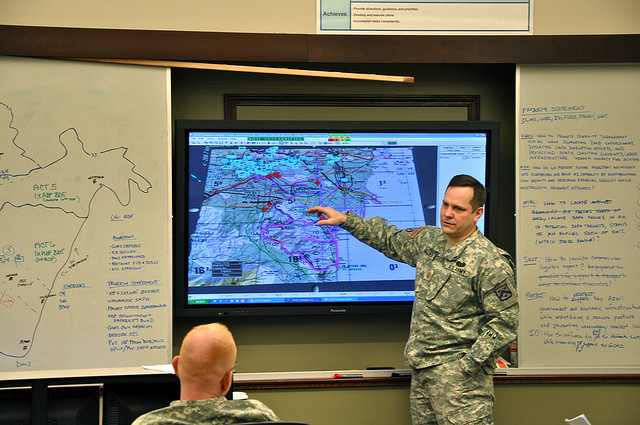
Every now and again I come across a job that, had I been born at a different time in a different country to different parents etc. etc, I really would have wanted to do. This job involves wearing a green suit and pointing at maps. In US Army speak it is an FA57:

"Functional Area 57 (FA57) is the Army’s Simulation Operations branch, though in fact FA57s are triple-hatted: they manage the use of simulations to provide simulated data to commanders and staffs during training; they manage mission command systems in order to help present real information to commanders and staffs when deployed; and they are the Army’s Knowledge Managers, responsible for organizing information so it is useful.  FA57s are expected to have both knowledge of the operational army, and also knowledge of computers, simulations, and battle command systems: they are expected to be able to translate between geeks and grunts in order to ensure that technical requirements and deliveries actually meet the needs of the field."
In other words, playing wargames and getting paid for it. I like the idea of having three hats as well. This is from an interview on Grogheads with Dr James Sterrett, the Deputy Director of the US Army Command and General Staff College’s Digital Leader Development Center’s Simulations & Exercises Division. Its a good read so if you have a yearning for an alternate career path go to Grogheads.

War Games still used in modern warfare

Another interesting thing I came across recently is this British Forces News item on professional wargames. I had not seen BFN before and I was very impressed with it. The video (at BFBS) includes interviews with Phil Sabin, Tom Mouat and Jeremy Smith and is well worth 2:40 of anyone's time. A matrix game on the Syrian insurrection makes a brief appearance.

Sunday, 6 October 2013

On the up...

Recovering from workplace trauma

The last few weeks at work have been pretty horrendous. It will be some time before things settle down a little and I will just have to persevere. My bloggering activities have suffered as a result because my mind is elsewhere. However, on the plus side the family is well and I have been engaging in some hobby related activity, albeit on a fairly low level.

I did manage to get to Derby the other weekend. I can't get used to the new venue. Although it is a simple 45 minute drive from my house, the parking is great and there are lovely views across the valley, the event lacks the ambiance of the Derby University atrium which was both relaxing and pleasant. As an example, these photos show the venue in use for gigs and interesting cars. Its great for these activities but as a great big box with no natural light (other than that filtering through the access doors) I find it gloomy and cramped.


I did however make an investment...


I have many Airfix Shermans and Matchbox Firefly's waiting to be built but, because Wargames Illustrated once gave away some plastic Valiant US infantry, I decided to have a go at PBI. Because the figures are true1/72 I bought some Armourfast Shermans to go with them. Two came in a pack and they looked OK but I really wanted three so I purchased a pack of three 1/72 Allied M4 A1s last year. This meant I had five and three of them came with cast hulls. They didn't look right with the Armourfast welded hull versions so I left everything for a while.

When I read that the new M4 A4s came with two alternate hulls, I had the idea of swapping out the cast hulls for the welded ones and the problem would both be fixed and produce some Fireflys. A cunning plan indeed.

I now have a total of 8 1/72 Shermans. The two original Armourfasts will remain unaltered. I have now started making up two cast hull M4 A1s which will become Sherman IIC Hybrids. These use the hull components of the M4 A1 and the Firefly turret. Beware that the pimply bit on the underside of the turrets is different between the two PSC sets. Choose the right components! I spent sometime wondering why things didn't fit and then levered off the half glued turret base and put the right one on!

Here is the first attempt...


I'm really pleased. Although there are a few fit issues, the model is very heavy and chunky. Very nice to handle.

Once I have built two IICs I'll make up the remaining cast hull vehicle with a spare M4 A4 hull to go with the Armourfasts (which are M4s with sand skirts and applique hull armour). The remaining M4 A4s will be made up as M4 A4 75mms (Sherman Vs). Funnily enough these will go nicely with my Valiant British infantry which will also do for PBI.

Even writing these thoughts up has cheered me enormously, as has the fact that at least one or two people have read earlier posts which I find very pleasing. Hi!

Well, this is obviously proof that workplace stress invokes a very weird reaction from the average wargamer who never needs an extra excuse to buy masses of the same thing and spend lots of time making these things into other things. Hey ho!

Sunday, 15 September 2013

Normandy numbers (1)

Pass the ammunition


One of the subjects I continually return to is Normandy. Not just D-Day but the campaign through to the liberation of Paris. It seems to me that the battle for the history of the campaign is as bitter as the actual fighting. If we leave aside the French and Germans (which we really shouldn't), we have an on going three way battle between the Americans, British and Canadians about who did what, how good they were (or not) and how bad Monty was.

My motto is "when the going gets tough the tough get the numbers and do the hard yards". There is a lot of good data about Normandy and our understanding of the campaign will be enhanced (even if the arguments are not resolved) by its full and sensible use.

I have recently been re-reading Max Hastings' book "Overlord" (Pan 1984). Appendix 5 contains "Some British Administrative Statistics" which I assume are from 21 Army Group. The data is familiar to me but I can't pin down the precise source. Probably not the best place to start a crusade for fact based history but certainly it is a first step. If anyone knows where this data originally came from, please let me know.

The data is for the period 12 June 1944 onwards. It gives rounds per month by gun type and rounds per gun per day. I have analysed this data and drawn up some graphs.

This first graph shows the rounds used per month. June numbers are smaller because the data is from 12th only. However, what started my interest is the large amount of mortar ammunition used in June. I assume because the artillery build-up, over the beaches, took time.


To take a closer look at the numbers I analysed the percentage contributions from each gun type. Mortar rounds are nearly 30% of total ammo use in June.
 

I then developed some "effective fire" values using some very helpful data I found at:
 
The effective fire values are based on the square root of the weight (in kgs) of the HE content of the shells. This shows, for a given weapon type, the relative effectiveness of its fire. Example values are 0.7 for a 3" mortar, 0.9 for a 25-pdr, 2.3 for a 5.5" gun and 3.6 for a 7.2" gun.


What I find really interesting about this data is the weight of fire contributed throughout the campaign by a fairly small number of medium and heavy guns (~450 guns out of some 2,500 total including mortars) but also the contribution made by divisional 3" and 4.2" mortars.

Time to find some data on American ammunition usage.....


Serious wargame planning

that looks like playing with toys....


At least that's what my wife says. Anyway, work being very tough at the moment I have had little time to think, let alone progress any of my projects. So I took a little time out yesterday to ponder the battle board.

This is not yet complete but I have managed to do some more painting and its coming along nicely. Another couple of goes and all of the basic colours will be complete. I then need to think about whether I outline the hexes and whether I spay with varnish. Both could quite easily send me back to the drawing board.

First, I used some of my A&A miniatures (the older style 12-15mm size). They fit quite nicely into the hexes and overall I think look quite good. The board with two Panthers about to hold off a couple of Shermans and an M24 but with an airstrike coming in.


Here comes the Tempest, I believe the term is dakka dakka dakka...woosh bang might be a bit childish!


Close-up of a surprisingly nice Panther.


I'm seriously considering whether I can use Norm Smith's Into Battle rules using the minis and this hex grid.

Next up is to deploy the 6mm ACW armies. With a river/sea board edge this might be Shiloh. Rebs converging on the Yankees.


I quite like the visuals, it looks rather neat but a couple of things occur to me. First, the base colours are darker than the board (i.e. the darker green which will be the colour for all full land hexes). Second, its hard to tell the sides apart from a normal distance from the board. I may need to colour code the bases. I'm still planning to use Neil Thomas' 19th century rules for this in a heavily modified format.

I thoroughly enjoyed playing around, sorry, seriously planning. I was therefore delighted to see Mr P Aspic has also been blogging about his battle board. I was interested to learn that his hexes are 7" across. Mine are just short of 54mm side to side. Whilst I would love to have a bigger battle board this size has been scientifically selected. It will allow me to play any of the Command and Colours games, the hex grid sizes for which vary slightly. I therefore have a gully between each hex to allow for size differences. I also have a very SECRET plan for the board which will make use of the gaps between the hexes, although this is on the back of an envelope for now.

Saturday, 7 September 2013

Reflecting

A trip down memory lane...

Instead of doing something more important, this morning I spent some time reading through Don's War Games. Neither of my two copies are originals, both were picked up years later second hand, my first copy being long lost. One is a 1972 reprint and the other a reprint from 1976 which looks like this. 


On reading it again I was really impressed with the book. In addition to the usual introductory material (like how to make your own lead soldiers!) the book has four sets of rules:
  • Ancients by Tony Bath
  • Horse and Musket (ACW) by Don
  • Modern Warfare by Lionel Tarr
  • Simplified Modern Warfare by Don
Each set of rules is accompanied by a description of a battle using the rules and a set of photographs showing how the games work. Quite frankly, these rules look quite good. They are straightforward, don't require a big table (two of the three games described are on 6' by 3' tables) and still look fun. The Tarr rules are a lot more complex and really need a bit more description about how to use them (number of men in a unit?) but they have a really interesting "strike point" mechanism for all fire other than small arms.

As well as being typically 1970s in style the dust jacket carries some great quotes from reviews:

"Unusual, interesting and entertaining" Yorkshire Evening Post
"Excellent layouts for historic battles" Daily Telegraph

It also carries an advert for Advanced War Games:

"A fascinating book for the war-games experts who can now regard their hobby almost as science" Manchester Evening News

Ironic given that Don's view of wargaming is that it is a pastime not a pseudo science!

My copy of Advanced War Games is a 1970 reprint picked up second hand and it looks like this:


It has some great content ranging from firing sticks and paper computers to something called the "Bulgin melee system" which sounds like a Common Agricultural Policy arrangement for peas, beans and lupins. Inevitably, complexity creeps in along with a lot of simply mad ideas. At this stage I was old enough to go off on my own adolescent complexity kick. I invested in the London Wargames Section Napoleonic rules (pink paper in a curly plastic binder with a picture of a gun on the front?) and had to learn about "impetus" whatever that was!

One last stop in memory lane is Solo Wargaming:


Mine used to look like this, a very nice hardback with great illustrations and suggestions about using matchboxes for hidden movement. Unfortunately I sold mine (for not much) to a second hand book shop in the early 1980s. I immediately regretted it but I haven't yet found the heart to buy one of John Curry's recent reprints. Well, one day maybe.

Time to get on with real life but perhaps a nice cup of tea first and some reminiscences about Airfix Combat Group soldiers and Napoleonic French Artillery.......and maybe Advanced Wargaming for bedtime reading!