Showing posts with label Real world wargames. Show all posts

Saturday, 8 October 2016

Professional grid game...

best game ever?

Ha, that's a loaded question! However, let's start at the beginning......

RAND Baltic game, hex grid overlay
I read with great interest the recent RAND organisation report on their Baltic wargame. Using lots of military types and what, to me, looks like a fairly standard NATO/Next War type game with 10km hexes, they have concluded that the Russians can overrun the Baltic states in 60 hours. Recommendation? Put in 7 brigades of additional troops including 3 armoured brigades as a deterrent. You can find the report here.

I mention the RAND game first because they have used a mix of a standard boardgame with little cardboard units that we are all familiar with in a combination with current military experience. The report is good, the concepts are great and the recommendations are probably very sound. Also, if you are interested in current developments in the east, their report is a great basis for some Cold War Commander battles.

According to Paxsims (one of my favourite sites): 
“full documentation of the gaming platform will be forth-coming in a subsequent report.” 
That will be very cool, can't wait.

The reason for mentioning this first is that RAND have been doing military analytics for at least 50 years, if not more, and they know what they are doing. The Baltic stuff is top notch. However, I have now found something that looks and feels like a major step forward. This is C-WAM!

Turkish M60s on the Iraqi border
The US Army have developed their own wargame, it is a map based game using a grid and counters. I don't have any pictures but General Dynamics IT have used the Freedom of Information Act in the US to get a copy of the rules. I have read them and, in my opinion, they are brilliant.

"Oh, alright, I surrender then!"
You can find the whole story here but, essentially, C-WAM (Centre for Army Analytics- Wargame Analysis Model) is a paper and dice based game. While its outputs are fed into a major IT system (Joint Integrated Contingency Model - big campaign management system), it is a battle simulation system that can be used in a very simple way (although you don't seem to be allowed just to do stuff unsupervised in the US Army!).

TOW: Great BBQ starter!
You can find a link to the rules here. I highly recommend reading them, Any experienced board or figure wargamer will feel very comfortable with the concepts. Just to convey some of these:

  • They use a square grid on a map;
  • Squares are 1 by 1 inch;
  • All units that take up space are represented on the map;
  • A grid square represents the area a brigade would occupy when deployed defensively;
  • Time scale is one or three day turns;
  • Squares may represent different sized areas depending on predominant terrain in the combat area e.g. 5km in rolling terrain;
  • Units are brigades;
  • Weather effects are very important, this is the first phase in a turn;
  • Cyber/Space/EW effects are included, you might be successful in dealing in a turn with information attacks and attacks on your space assets (satellites) but you may suffer degradation of in electronic warfare terms;
  • Intel/Surveillance/Recce effects are merged into a targeting value, if you are moving in a J-STARs area you are detected! Otherwise you are detected it there is a targeting value success. Special forces are primarily an information gathering/targeting device!
  • Deep strike bombardments (ballistic missiles, cruise missiles, air packages), atmosphere penetrators (oooer missus);
  • Integrated air defense system "gates" and air to air combat;
  • Forward Area Logistical Supportability: supply to you and me;
  • A major naval warfare sub-system (not useful in the desert but...);
  • Reception, Staging, Onward Movement and Integration (RSOI) Operations: reinforcements anyone?
  • Manoeuvre and stacking (that would be "battlespace limitations"!);
  • Force Multiplier Combat Values: artillery support;
  • Ground force combat with tables and die rolls!

Syrian forces exposing themselves to ISR detection
It says in the rules that they are not to be used without appropriate support. I agree. They are not a complete set on their own but, rather, a tool kit that needs to be carefully managed.


Are they the best game ever? No, but they are such a major insight into real-world wargaming and current US doctrine that they are extremely important. if you don't wear green pyjamas, reading these rules is the closest you will get to the smell of gunpowder. Oh, by the way, they use a square grid, how interesting is that! 

Wednesday, 3 September 2014

More Strategos

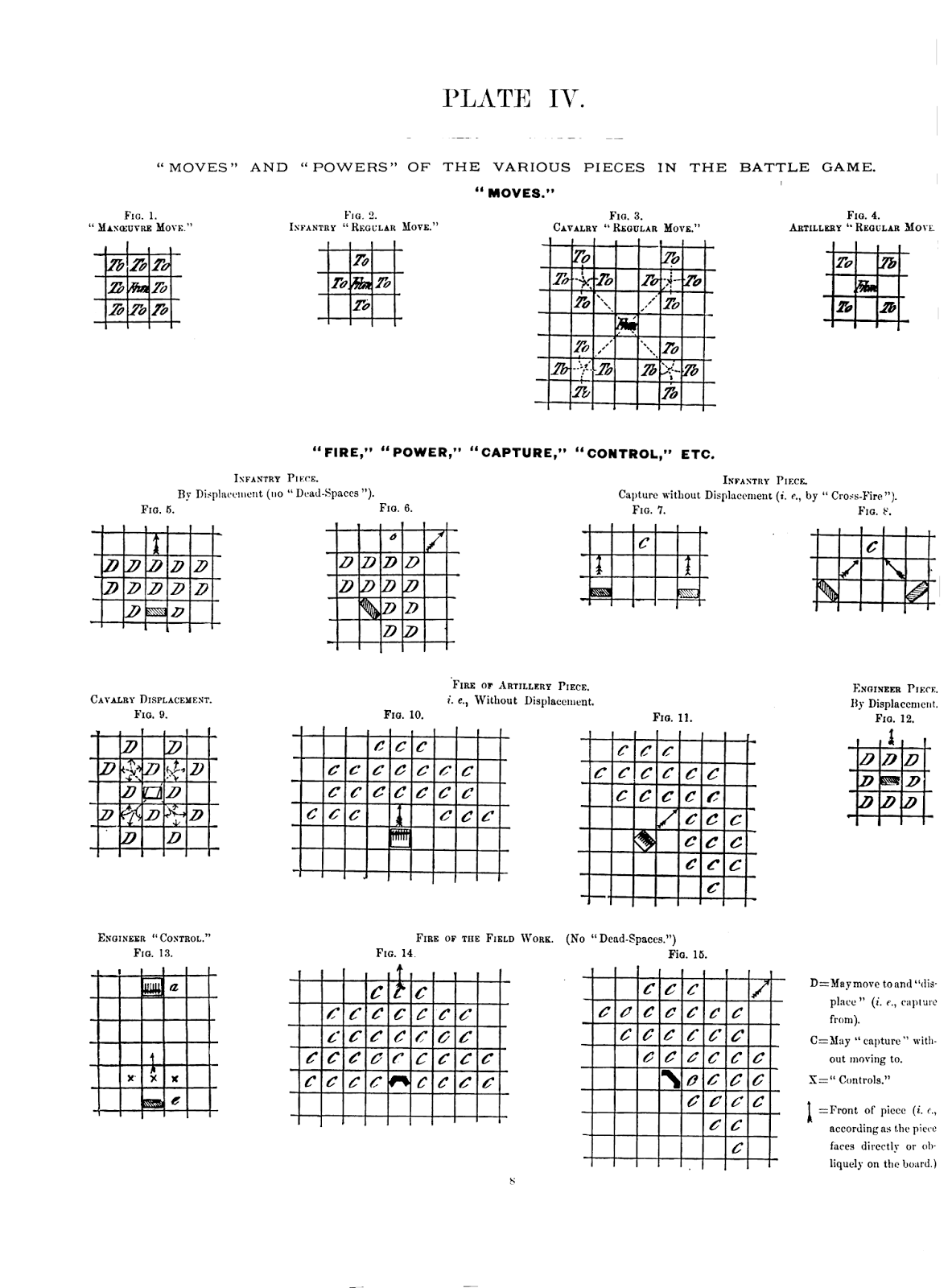
Volume 2 of Strategos can be found here. It contains plates, tables and statistics such as....


New Victorian military wargame!

Strategos by Charles Totten US Army 1880

I came across this through a chance reference on BGG. It is by a US artillery lieutenant and published in two volumes in 1880 with the approval of the US army. It is of interest for a number of reasons:

1. I don't think I have ever heard of this work before and it may be missing from our collective view of the development of the wargame (it is not mentioned in Martin van Creveld's recent study for example).

2. It is a clear successor of von Reiswitz, von Tschishwitz and Baring's rules, although Totten claims to have developed his rules without reference to other games.

3. It is complex, multi-layered and multi-purpose, perhaps to the point of being too complex to use (I've heard that one before somewhere!).

You can find a digital version at Hathi Trust. For ease of reference I append here the title page and index. Enjoy!


Friday, 11 October 2013

Gissa job!

Thankfully not more work angst


Sterrett3

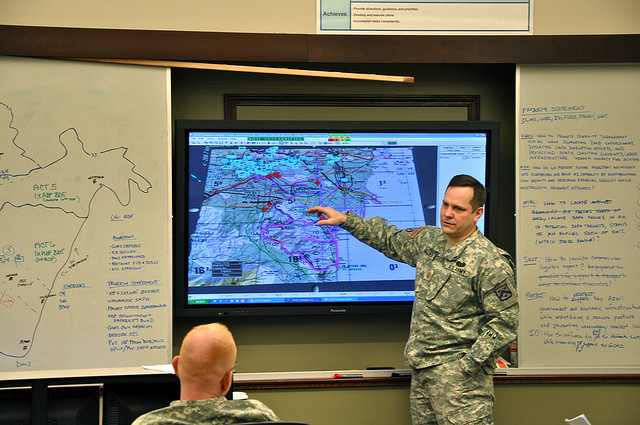
Every now and again I come across a job that, had I been born at a different time in a different country to different parents etc. etc, I really would have wanted to do. This job involves wearing a green suit and pointing at maps. In US Army speak it is an FA57:

"Functional Area 57 (FA57) is the Army’s Simulation Operations branch, though in fact FA57s are triple-hatted: they manage the use of simulations to provide simulated data to commanders and staffs during training; they manage mission command systems in order to help present real information to commanders and staffs when deployed; and they are the Army’s Knowledge Managers, responsible for organizing information so it is useful.  FA57s are expected to have both knowledge of the operational army, and also knowledge of computers, simulations, and battle command systems: they are expected to be able to translate between geeks and grunts in order to ensure that technical requirements and deliveries actually meet the needs of the field."
In other words, playing wargames and getting paid for it. I like the idea of having three hats as well. This is from an interview on Grogheads with Dr James Sterrett, the Deputy Director of the US Army Command and General Staff College’s Digital Leader Development Center’s Simulations & Exercises Division. Its a good read so if you have a yearning for an alternate career path go to Grogheads.

War Games still used in modern warfare

Another interesting thing I came across recently is this British Forces News item on professional wargames. I had not seen BFN before and I was very impressed with it. The video (at BFBS) includes interviews with Phil Sabin, Tom Mouat and Jeremy Smith and is well worth 2:40 of anyone's time. A matrix game on the Syrian insurrection makes a brief appearance.